The AI video generation space has exploded. In 2024, there were a handful of tools. Today, there are dozens — each making bold claims about cinematic quality, creative freedom, and ease of use. If you have a story to tell and you want to see it on screen, which tool do you actually reach for?
This comparison focuses on one specific use case: you have a written story, scene, or script, and you want to turn it into a short video. Not stock footage. Not slideshow-style clips. A genuine narrative film moment.
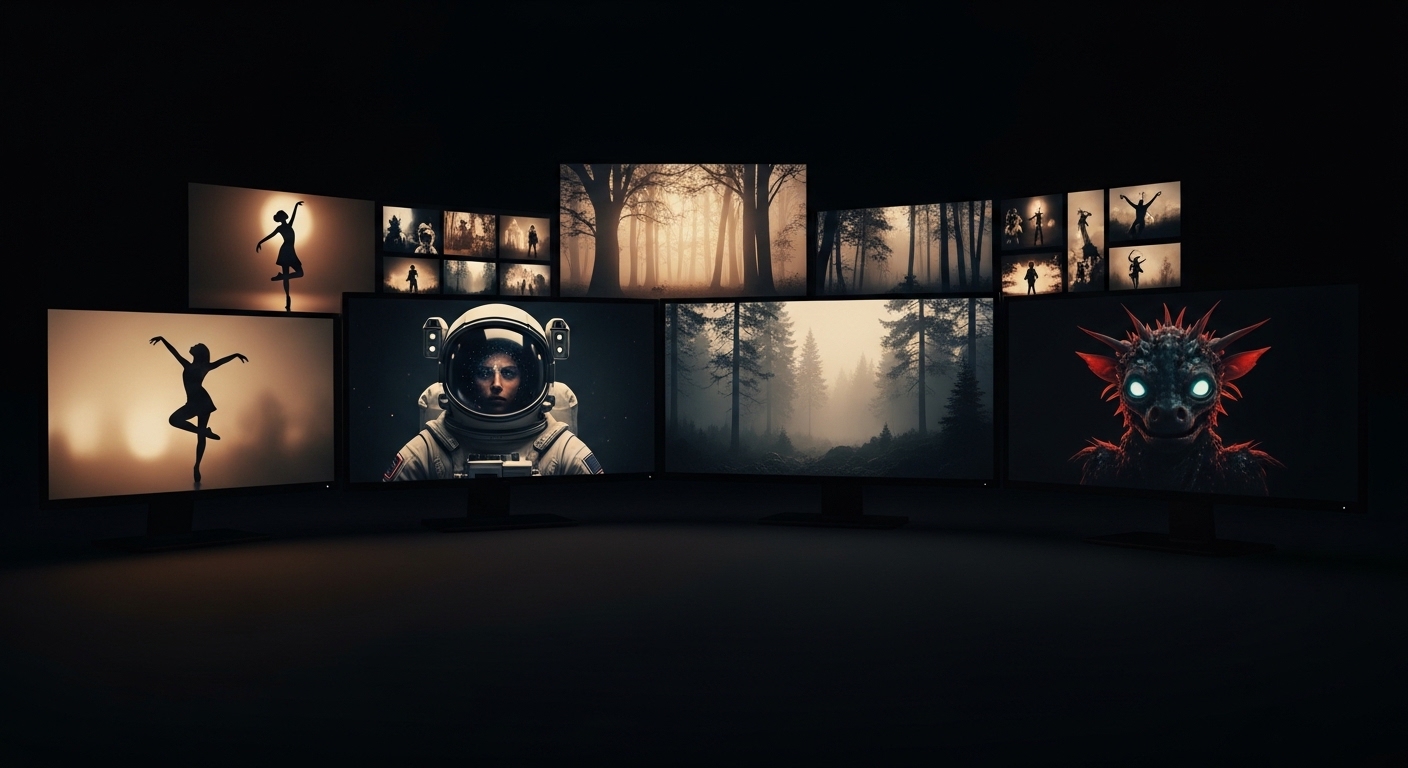
Each tool produces radically different results from the same prompt — knowing why matters more than knowing which is "best".
What We Tested
We tested five of the most prominent AI video generators available in 2026: Runway Gen-3, Pika 2.0, Kling AI, OpenAI Sora, and Plotfire Pro. For each tool, we submitted the same story prompt — a scene of a dancer performing alone in an abandoned theatre — and evaluated the output on visual quality, narrative coherence, prompt fidelity, and ease of use.
Runway Gen-3 Alpha
Runway is the professional's choice and has earned that reputation. Gen-3 Alpha produces genuinely cinematic footage — film grain, natural lighting shifts, smooth camera motion. The outputs feel like they belong in a short film festival.
The trade-off is prompt complexity. Runway rewards users who write detailed, technical camera prompts: "slow dolly right, shallow depth of field, golden hour backlighting". If you give it a narrative story paragraph instead of a camera direction, the results become inconsistent. It is a cinematographer's tool, not a storyteller's tool.
Pricing: Credits-based subscription starting around $15/month. High-quality outputs can burn through credits quickly.
Pika 2.0
Pika is the most accessible of the major players. The interface is clean, the generation speed is fast, and the outputs have improved dramatically since version 1.0. For short social-media-ready clips, Pika punches above its price point.
For story-driven work, it falls short. Pika generates stunning individual moments — a splash of water, a figure in silhouette — but has no concept of narrative continuity. Each generation is a standalone clip. If you want scenes that connect into a story arc, you're editing multiple Pika clips together manually.
Pricing: Free tier with limited generations; paid plans from around $8/month.
Kling AI
Kling AI, developed by Kuaishou, has become one of the most talked-about tools of 2025–2026. It generates longer clips than most competitors (up to two minutes in some modes), handles motion physics well, and produces realistic human movement — notoriously difficult for AI video models.
Its weakness is English-language story prompting. The tool is optimized for Chinese-language workflows, and story-driven prompts in English tend to produce generic outputs. The visual quality is there; the narrative interpretation is not.
Pricing: Credit-based; roughly $0.14–$0.35 per clip generation depending on quality settings.
OpenAI Sora
Sora is arguably the most technically impressive model on this list. Its understanding of physics, spatial reasoning, and long-form temporal coherence is ahead of competitors. Multi-character scenes, complex environments, and nuanced motion are all handled with remarkable accuracy.
The limitation is access. Sora remains gatekept behind ChatGPT Plus and Pro tiers, and generation limits are strict. For users who get access, it's transformative. For everyone else, it's a preview of what's coming.
Pricing: Included in ChatGPT Pro ($200/month) with generation caps; lower tiers have restricted access.
Story-first tools let you think like a writer, not a cinematographer.
Plotfire Pro
Plotfire Pro takes a fundamentally different approach. Rather than asking you to write a technical camera prompt, it asks you to write like a human: a short paragraph, a scene idea, a character moment.
The platform then runs a brief refinement process — asking up to four follow-up questions about tone, mood, pacing, and visual style — and converts your answers into an optimized generation prompt automatically. You never need to know what "negative space composition" or "rack focus" means. You just need to know what you want to feel.
The result is a one-minute short film clip delivered to your dashboard. No editing, no stitching, no manual prompt iteration. The story drives the output, not the other way around.
For pure cinematic quality, Sora and Runway have an edge. But for story-first creators — writers, authors, creative directors — Plotfire Pro is the most direct path from idea to watchable film.
Pricing: Pay-per-video credit packs. Credits never expire. No subscription required.
Head-to-Head Summary
| Tool | Story-first? | Visual quality | Price | Best for |
|---|---|---|---|---|
| Runway | No | Excellent | Subscription | Pro filmmakers |
| Pika | No | Good | Freemium | Social clips |
| Kling | Partial | Very good | Credits | Long clips |
| Sora | Partial | Outstanding | High subscription | Complex scenes |
| Plotfire Pro | Yes | Good | Pay-per-video | Writers & storytellers |
Which Should You Use?
The answer depends on your starting point. If you already think in camera angles and you want maximum visual quality with full control, Runway or Sora are your best bets. If you want quick clips for social content, Pika is fast and affordable.
If you have a story — a character, a moment, an emotion you want to visualize — and you want to go from words on a page to a watchable film clip in under ten minutes without learning prompt engineering, Plotfire Pro is the shortest path there.
The question was never which tool generates the most impressive pixels. It's which tool serves your creative process. For writers, that answer is increasingly clear.
Want to try it yourself?
Write a scene, answer a few questions, and get a one-minute short film delivered to your dashboard. Create your story →